
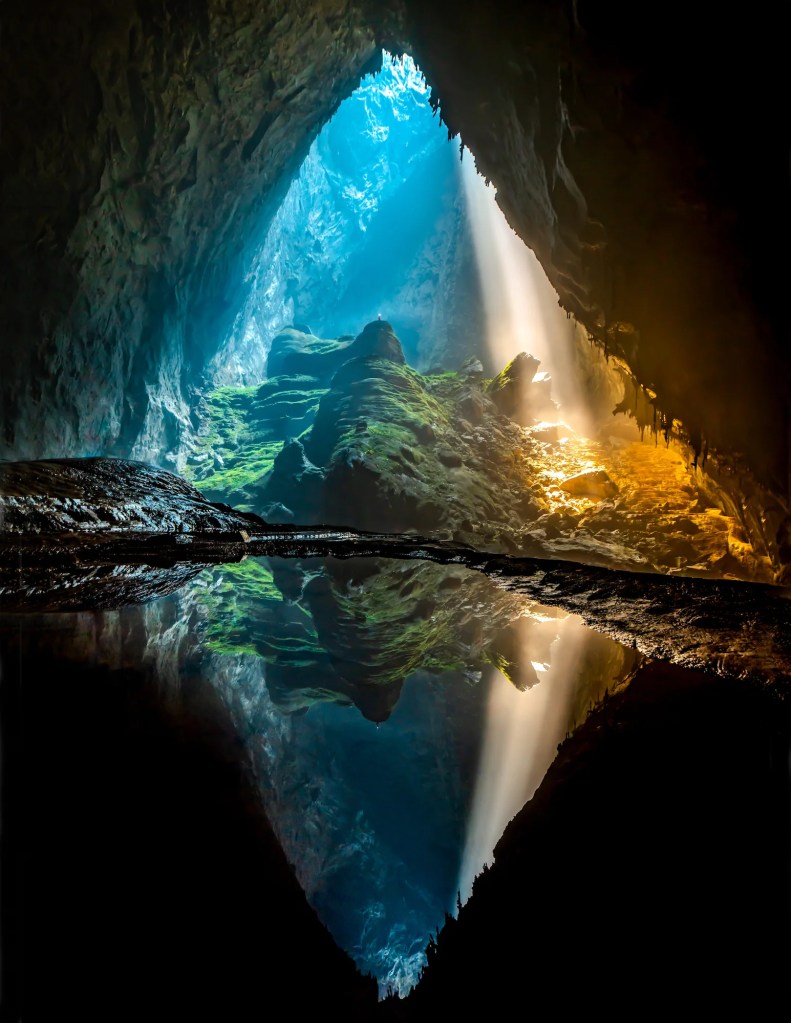
Would you believe me if I told you that beneath your feet was a nearly undiscovered world full of tunnels, rivers, waterfalls and never before seen rock formations? Well, just below Earth’s surface is an entire world that remains largely undiscovered. This isn’t some crazy Hollow Earth theory or other conspiracy. This is about the cave system that makes up our underground landscape.
Early Composition
There are many types of caves and just as many different ways they are formed. Some can be formed after tectonic activity, while others can before from lava. However, caves formed through solutions (called solution caves) have a different story.
Solution caves aren’t just found anywhere in nature. It takes a very specific mixture for a cave to form. Earth’s crust is made up of several different types of material including: granite, silicone and iron. These materials are too strong and do not exhibit the characteristics needed for cave formation. Instead a mixture of dolomite, limestone and gypsum salt are needed and are the building blocks of some caves.
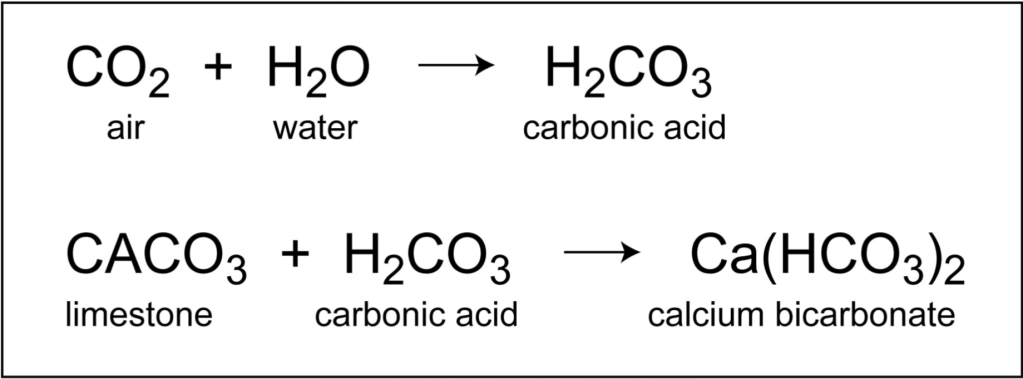
What is it about this particular mixture that is so important? In order for a cave to form, water must be present. As water enters the soil in the form of rain, the water molecules collect carbon. Carbon is deposited in the soil from the decaying plants, organisms and other terrestrial processes. As the water absorbs the carbon in the soil, carbonic acid is formed. As carbonic acid seeps further into the limestone, the acid reacts with the calcium (Ca) in the limestone. As the calcium is removed, the limestone is dissolved in the carbonic acid, forming calcium bicarbonate. A similar reaction creates potholes and sinkholes in the spring and summer months.
The Power Of Water and Time
Many factors effect how much limestone is dissolved in water. The amount of available carbon dioxide and temperature are just just two. Most caves form at or just below the water table. The water table is an underground boundary where the dry unsaturated soil meets the dampness of underground water. This is the level where water begins to fill the space between soil and rocks. Above the water, oxygen and carbon dioxide fill spaces between rocks and sediment (called the zone of aeration).
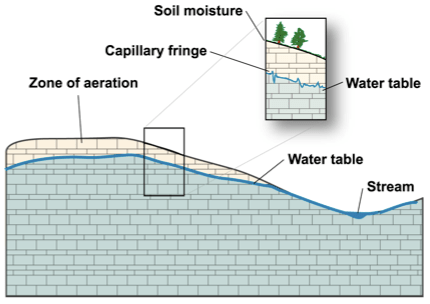
This level is important for two reasons. The first is water movement slows down and the second is temperature. Water trapped between the soil and rocks does not have a lot of horizontal movement; it’s mostly stable. So acidic water, deposited from the rain, is stationary for longer allowing for more limestone to be dissolved.
The second reason is temperature. Ground water can be much cooler than water coming from the surface. This means (because of some complex chemistry) when water of varying temperatures blend, the resulting mixture can accelerate chemical reactions, including dissolving limestone, even if the water is already saturated with carbon dioxide and calcium.
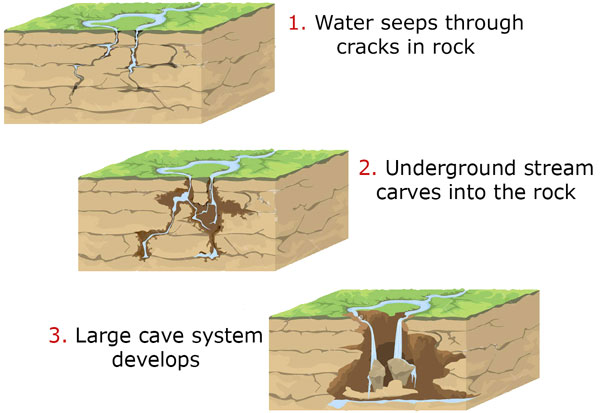
The above illustration loosely breaks down the process discussed above. While underground streams do play a role in cave formation, the chemistry of dissolving the rock at the water table is what makes caves so unique. Fast forward thousands or millions of years and what remains is a cavity full of life and rock formations never before seen which can serve as a blueprint for what Earth looked like in its infancy.
Rock Formations
Stalactites and stalagmites are two of the most common cave formations. These icicle shaped rock formations are unique to solution caves. Stalactites descend from the ceiling while stalagmites push up from the ground. If you forget which is which, just remember the saying “stalactites hold TIGHT to the ceiling while stalagmites push up with all their MIGHT.” However, stalactites are not really “holding onto” the ceiling and stalagmites are not really pushing up.
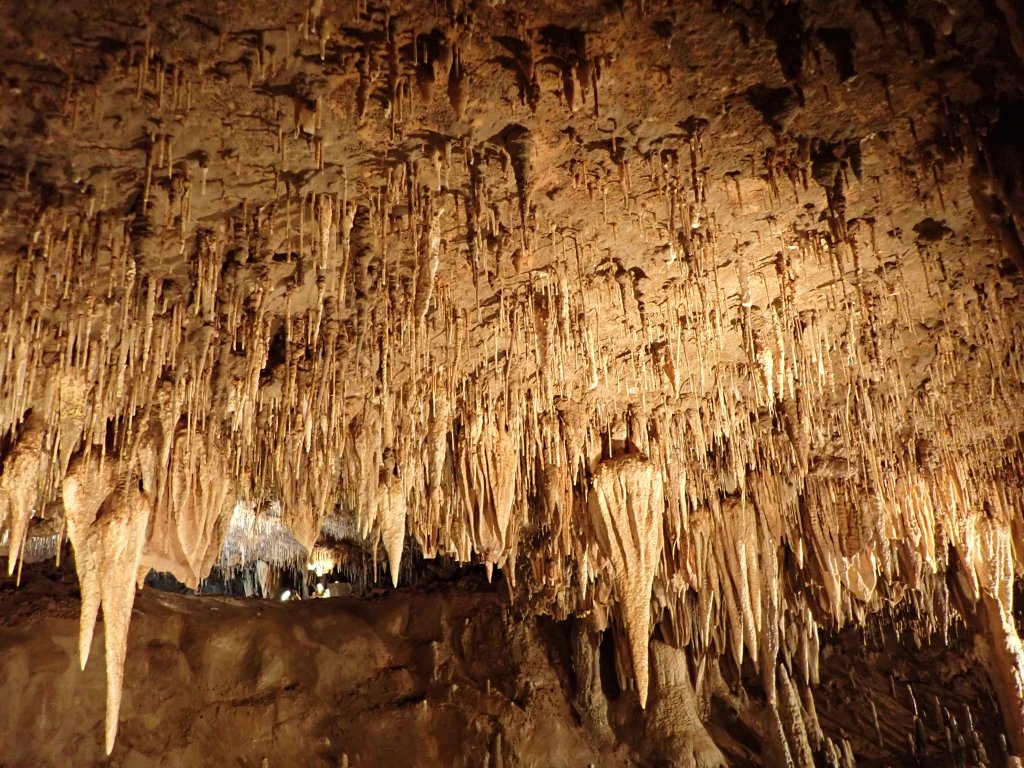
Stalactites form when water and CO2 first come into contact with a limestone layer. The acidic water breaks down the limestone (as discussed earlier). However, when the acidic water and limestone mixture comes in contact with the air from a cave ceiling. The CO2 is removed and the limestone mineral is redeposited on the ceiling.
As water droplets continue to drip into the cave, they follow the same path, each drop depositing more limestone. Overtime the limestone deposits grow into the icicle like structure. Essentially water is acting like a transporter for limestone minerals; getting collected as soon as it contacts; and getting redeposited along the ceiling of the cave.
Stalagmites are exactly the same in terms of composition and structure, only on the ground. They often form under stalactites because as water drips from the ceiling, any remaining limestone not deposited along the ceiling, will get deposited on the cave floor when the water impacts the ground. Stalactites and stalagmites often grow at similar rates; when they connect, they form a column.
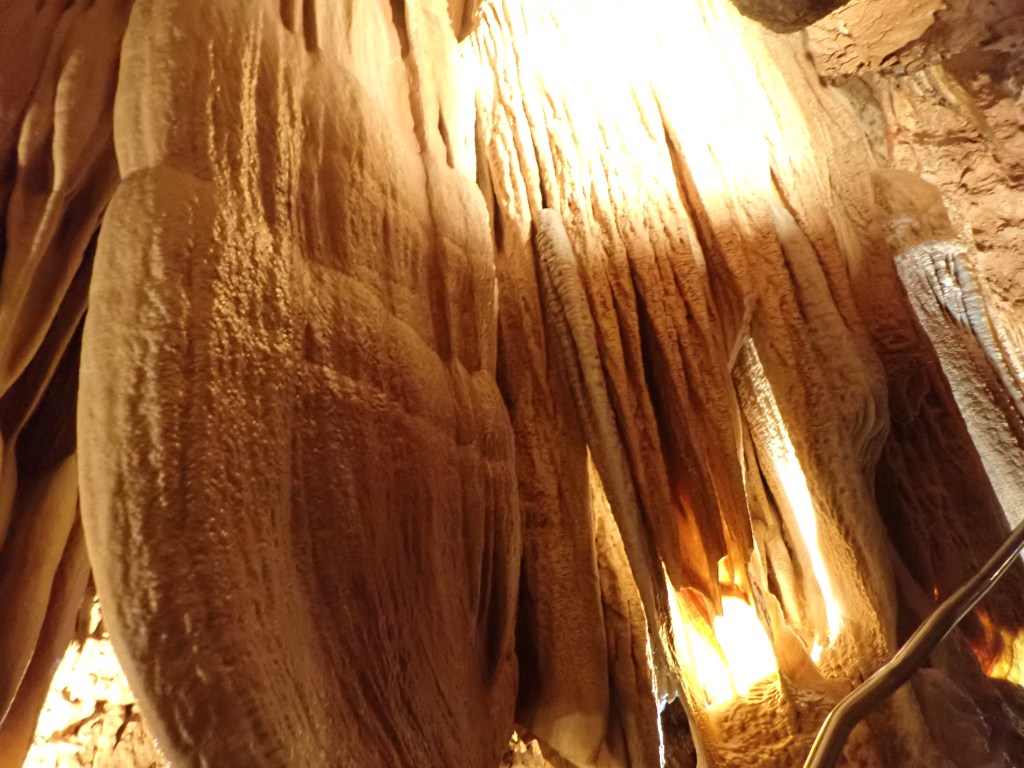
Since water flow determines the rock formations, and there are an endless number of caves with different layouts; no two formations will be exactly alike. It all depends on the path seeping water taken within the cave. This picture is of a flowstone formation, taken in Meramec Caverns located in the Ozarks in Missouri.
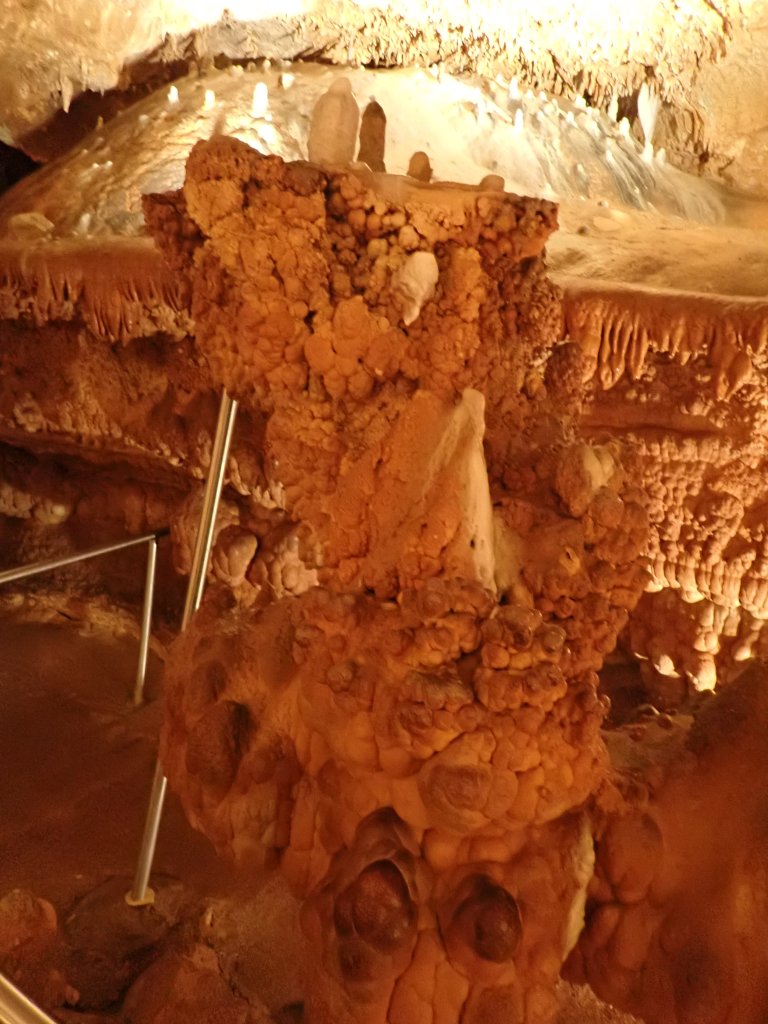
One of the rarest formations is also located in Meramec Caverns, and its called the wine table. Only two configurations of this formation have been discovered, the other is located in Sicily. The structure stands slightly over 6ft (1.8M) tall and is supported by 3 natural legs made up of aragonite (a specific structure of limestone). The exact mechanism for how this structure formed is not fully known. However, with caves dotted all over the world, each with their own quirks, there are tons of formations that are unique to just one cave.
Habitats and Microclimates
Now discovering a massive hole in the Earth’s crust might worry most people. However, caves provide a safe haven for endangered species and organisms. Caves provide shelter and a relatively stable climate for a lot of organisms. According to the National Cave and Karst Research Institute, a cave’s climate is broken into 3 sections.
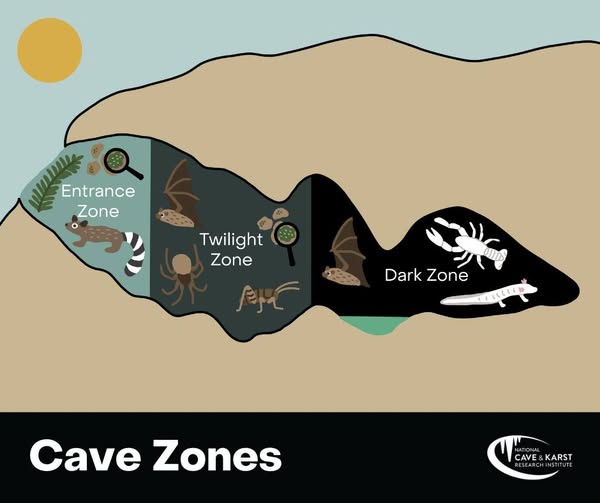
The entrance zone is the area closes to the entrance. This area still receives sunlight from the outside and the temperature and air conditions will change as the outside weather changes. This is where animals like racoons, birds, frogs, squirrels and other terrestrial animals will seek shelter. Since this area still receives some sunlight, often times vegetation will grow near the openings. If a cave has multiple openings, there could be multiple entrance zone areas of climate.
The second zone is the twilight zone. This area is a little further into the cave, but not far enough to be in complete darkness. This is where most crickets, spiders bats and other insects will call home when not outside. While sunlight can reach this area, there is not enough light to support vegetation. The last zone is the dark zone, which is in complete darkness. Animals that make it this far into the cave need some other form of navigation. For example bats can make their way around via echolocation. This zone is so unique, some species adapt for permanent residency in the cave and will not survive outside.
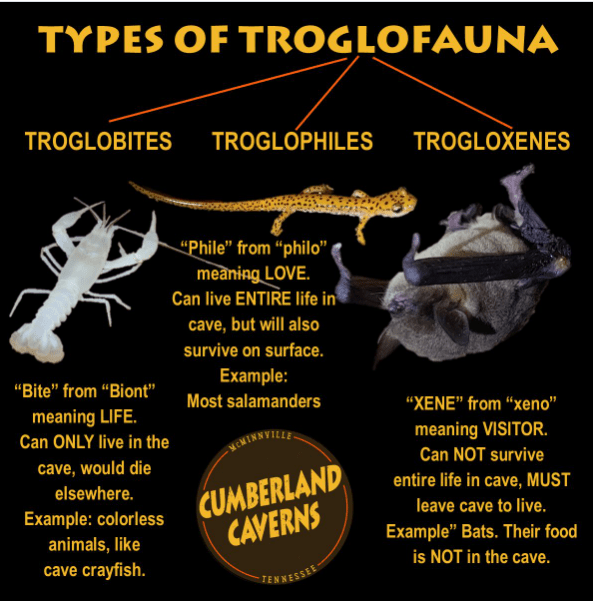
The temperature in the twilight and dark zone can remain pretty constant regardless of what the outside temperature is. This consistency means organisms that require a specific habitat can likely find it within the cave. Caves with one entrance tend to be the most stable in temperature and humidity, however they also have the least amount of airflow. Caves with multiple entrances will have higher airflow, but be more susceptible to changes in the outside conditions.
Scientific Benefits
In addition to providing habitat to some species, caves have a scientific purpose as well. Caves form over millions of years, and during that time Earth goes through several changes. However, the rock and conditions within remain relatively stable. As rainwater enters from above, trapped within the water droplets are telltale signs of the conditions on Earth. For example, if Earth had high levels of a particular chemical, that chemical will be collected within the water droplet and deposited on the rocks of the cave. Stalagmites and stalactites tend to offer researchers the most information because the water required for their formation can come from several millenniums, each with their own unique snapshot of Earth’s conditions.
Because caves are a form of shelter to different types of animals, that also means there are the remains of animals hidden within the caves. In 2023 a new species of prehistoric mammal was discovered in Carlsbad Caverns in New Mexico. According to the New Mexico Museum of Natural History and Science, the fossil is a close relative of the modern day Muskox that dates back to the last ice age. The fossil has helped researchers identify what mammals were living in the area during the last ice age as well as help connect the links to modern day species. Other items recently discovered in caves include corals, sharks and different types of insects.
Conclusions
Caves offer researchers a look into the past. Whether it’s through Earth’s composition, or a species that once dominated the globe, caves are a picture of our past. Today caves have become tourist attractions for families and thrill seekers alike. Most established caves like, Mermac Caverns, offer family friendly tours to see these structures up close
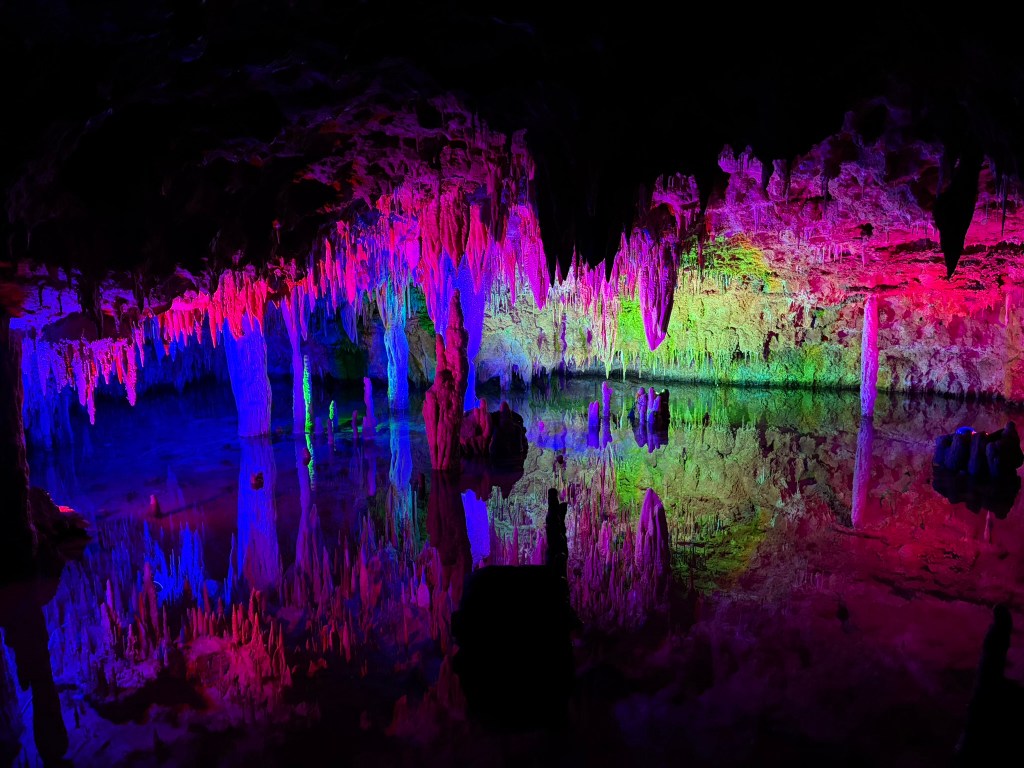
It doesn’t matter if you’re an experienced caver looking for a new passage previously unseen, or just a family looking for an afternoon activity; there is something for everyone. So the next time you see a sign for the caverns, maybe stop by, because you never know what you’ll find inside!
References
- https://www.sciencelearn.org.nz/resources/3325-why-caves-matter
- https://www2.bgs.ac.uk/mendips/caveskarst/caveform.htm
- https://www.nps.gov/maca/learn/nature/stalactites-stalagmites-and-cave-formations.htm
- https://www.nps.gov/grba/planyourvisit/cave-geology-in-depth.htm
- https://education.nationalgeographic.org/resource/water-table/
- https://nckri.org/about-caves/cave-environment/
- https://caveconservation.com/who-lives-in-caves/
- https://www.sciencelearn.org.nz/resources/3325-why-caves-matter
- https://www.newmexicoculture.org/release/1897/30
- https://www.nps.gov/maca/learn/nature/fossils.htm
- https://www.usgs.gov/programs/climate-adaptation-science-centers/news/microclimates-research-leads-discovery-new-species
 Off The Trails: A Hiker's Guide to the Outdoors