
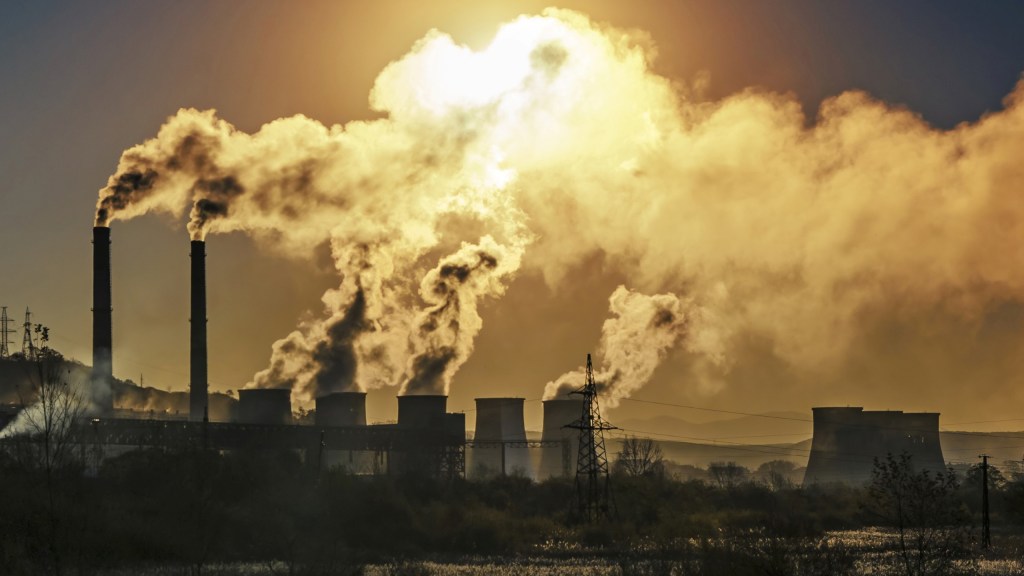
If you’ve been watching the news, then you’ve probably heard the term “Greenhouse Gas”. You’ve also probably listened to some news anchor explain how bad they are and how we need to abolish them. However, most of them don’t fully explain what they are, or how they affect Earth.
The Sun
In short, greenhouse gases are gases in the atmosphere that trap heat, much like a greenhouse. As the sun burns, the heat and light emitted travel through space to Earth. It’s the sun’s rays that cause the change in temperature between day and night. These greenhouse gases absorb the rays and trap it in the atmosphere. This is called “The Greenhouse Effect”. Over time, the greenhouse effect can have major implications for Earth’s temperature.
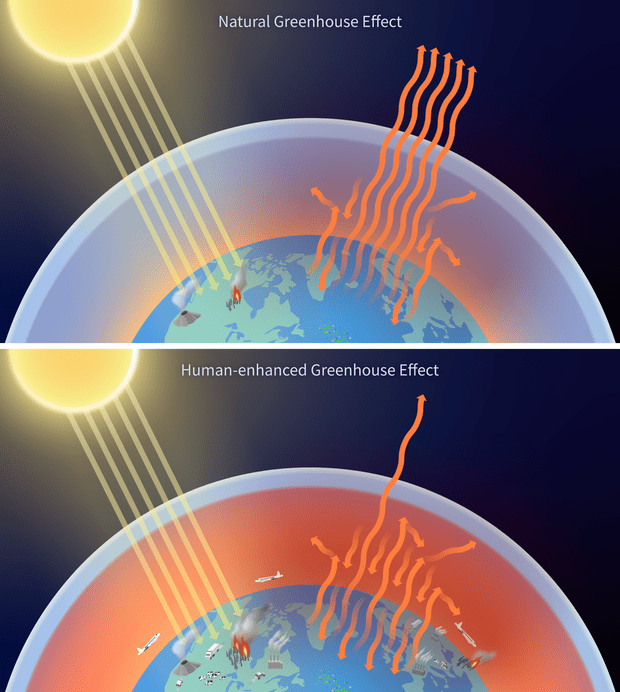
However, how much radiation is too much? According to NASAs Earth Observatory, about 30% of all radiation that strikes Earth is reflected back out to space via clouds, ice crystals and other reflective surfaces. The other 70% is absorbed by the land and ocean. This radiation can be in the form of visible light, ultraviolet light (UV) and Infrared Radiation (IR). These various forms of light all behave differently once they enter the atmosphere. For example, UV rays are what cause sun burns and skin cancer when outside, while visible light can cause rainbows.
Our Atmosphere
If we want to understand greenhouse gases, we need to understand our atmosphere. If you ask the average person, they will likely tell you that Earth’s atmosphere is mostly Oxygen. However, that is not the case. According to National Geographic, our atmosphere is 78% nitrogen, 21% Oxygen, .9% Argon and .1% other gases. Still, Oxygen is essential for nearly all life, and our bodies cannot function properly without it.
However, greenhouse gases make up only about .1% of all gas in our atmosphere, which equates to about 1,000 PPM. To put that into scale, if Earth’s atmosphere were compressed to a gallon of water, Greenhouse gases would make up less than a teaspoon of liquid.
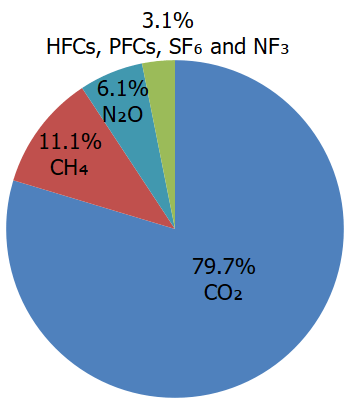
According to the EPA, there are 4 types of greenhouse gases: Carbon Dioxide (CO2), Methane (CH4), Nitrous Oxide (N2O), and Fluorinated hydrocarbons. Carbon Dioxide accounts for the majority of greenhouse gas emissions. Sources for CO2 and Methane include the burning of fossil fuels. Natural sources like volcanos, wetlands and hot springs account for almost 80% of all CO2 and Methane emissions. Nitrous Oxide is often emitted as a biproduct of agricultural activities. While fluorinated hydrocarbons such as freon are often found in air conditioning systems and refrigerants.
How Greenhouse Gases Trap Heat
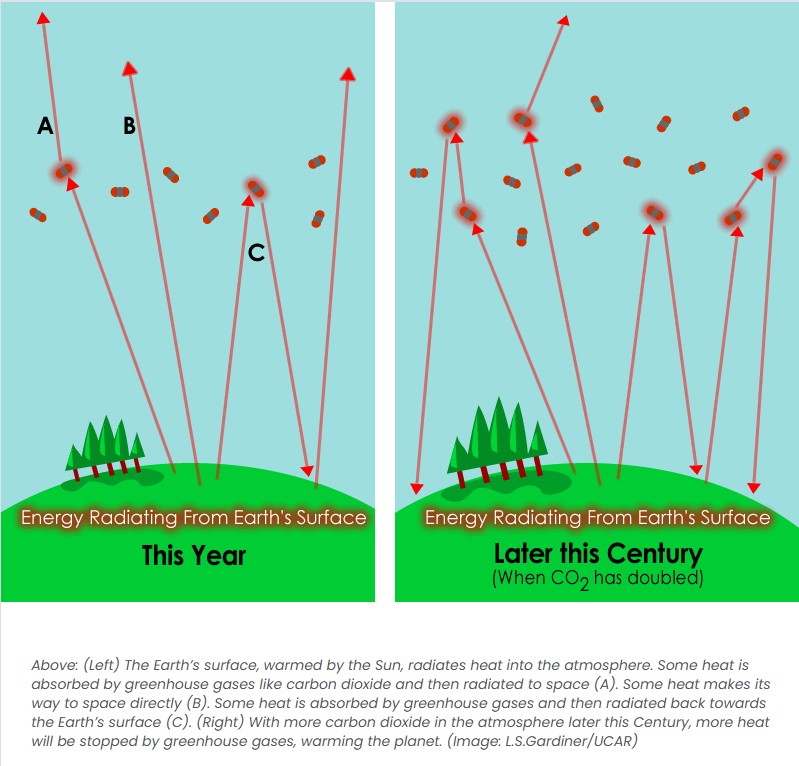
Greenhouse gases don’t really trap heat; instead they vibrate, releasing their own heat. These molecules are very complex and are made up of 3 or more atoms (i.e. 3 elements from the periodic table) that are loosely bound together, yet strong enough not to break down under ultraviolet light or infrared radiation. When radiation from the sun reaches Earth, these molecules vibrate, releasing heat. This heat is then captured by other greenhouse gas molecules perpetuating the greenhouse effect. They don’t necessarily trap heat, but rather vibrate in the presence of heat, creating more heat.
The Greenhouse Effect
As stated earlier, the greenhouse effect is the change in temperature caused by the presence of greenhouse gases in Earth’s atmosphere. The greenhouse effect occurs naturally with molecules like CO2 and Methane. This process helps keep the Earth’s temperature constant. Without the greenhouse effect, Earth could become too cold to support life. However, too much, and Earth will become too warm; the greenhouse effect has to be just right to support life.
The severity of the greenhouse effect caused by different chemicals can vary depending on how long these chemicals remain in the atmosphere. Biologists and environmentalists use a term called bioaccumulation to understand and explain how various chemicals affect different organisms. In our example, Earth is the organism being studied, but the principal is the same.
In order for something to be detrimental to the environment, a few criteria must be met. First, the chemical introduced must be hazardous. In this case, the hazard is the heat generated. Second, the chemical must persist in the environment long enough to cause damage. A chemical will be less dangerous if its presence in the atmosphere is very short (just a few days) because there won’t be enough time to cause any significant harm. This can only occur if the rate of intake (or rate of emission in this case) is higher than the rate of removal. This is where the story of greenhouse gases gets murky.
The Most Dangerous Greenhouse Gas
How long each chemical persists varies from just a few years to thousands of years. Carbon Dioxide can persist for over 1,000 years and is often used to help researchers date old rocks and ancient artifacts, hence the name carbon dating. Fluorinated Hydrocarbons can persist for a few years to decades before breaking down. Methane can persist for about 10 years, while Nitrous Oxide can persist for about a century.
While CO2 is the most prevalent and most discussed greenhouse gas, is it the most harmful? A study conducted by EA Engineering (EA) aimed to identify which greenhouse gases are the most dangerous. Researchers used the Global Warming Potential (GWP) created by the Kyoto Protocol to study the dangers of various greenhouse gases. The GWP takes into account things like the ability to trap radiation and how long the chemical persists in the atmosphere. The study used Carbon Dioxide as a benchmark of 1. Anything greater than 1 was worse than CO2, while anything less than 1 was better than CO2. Their findings are outlined below.
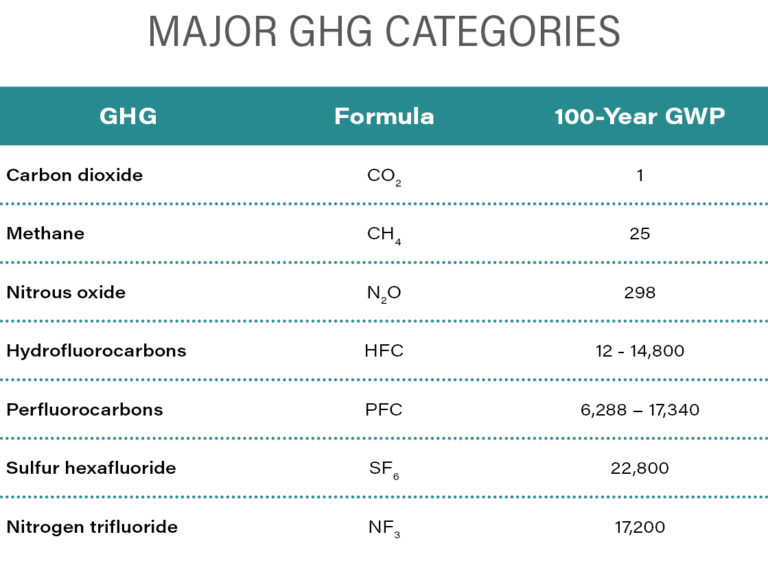
According to the EA study, Fluorinated Hydrocarbons (known as short-lived climate pollutants, or SLCPs in their article) have the greatest impact on Earth’s atmosphere. They also found that Fluorinated Hydrocarbons account for 40%-45% of temperature changes experienced since 1880, about 1 degree Celsius. It would make sense that these gases are the most harmful to the atmosphere. They are fully synthetic (man made) which means nature may not be able to deal with their presence, and are designed to control temperature in the form of refrigerant and air conditioner fluid.
Why is this groundbreaking? With all the talk about moving to carbon neutrality by 2030 or 2050; carbon neutrality won’t fix the problem. Fluorinated Hydrocarbons also have to be addressed. Right now, there’s very little talk surrounding Fluorinated Hydrocarbons and even less movement on how to deal with their presence.
Carbon Dioxide occurs naturally. Even if we push to move toward carbon neutrality by limiting emissions or driving distances, carbon emissions will still persist. Fluorinated Hydrocarbons don’t occur naturally, so finding replacement chemicals that serve the same industrial purpose will have a bigger impact than any carbon movement could.
How To Remove Greenhouse Gases
A lot of countries and organizations are moving toward carbon neutrality by limiting driving or mandating electric vehicles. These policies will do very little in reducing greenhouse gases. Electric car production has their own emissions in the form of mining, and charging the vehicles draws power from a substation, which in the U.S are mostly powered by fossil fuels. Removing CO2 from the atmosphere should come in the form of reforestation, since plants use CO2 for photosynthesis. This can come in the form of ocean fertilization or planting more trees.

Another technology being developed is direct air capture. This involves using scrubbers to capture the CO2 in the atmosphere and store it underground or repurposing in products like concrete. Unfortunately, all of these technologies require money and time, something most companies don’t have.
There is also very little talk about removing Fluorinated Hydrocarbons from the atmosphere. Researchers aren’t even sure if they can be removed. Some states have begun to limit their production and usage, but this is not widespread.
Conclusions
The green movement shouldn’t come in the form of electric vehicles or riding bikes everywhere. Carbon neutrality will only get you so far in reducing the impact of greenhouse gases. Regulating vehicles and travel won’t fix the issue. Carbon Dioxide occurs naturally and at one point was much more abundant than oxygen. Earth has been here for over 4.5 billion years and will remain for another 4 billion years. Nature finds a way to always achieve equilibrium with naturally occurring chemicals. If we want to have a true impact on greenhouse gases, the focus should shift to Fluorinated Hydrocarbons, which don’t occur in nature and have a much bigger impact on the atmosphere. If we maintain our presence and stick to what is natural, nature will take care of the rest.
References
- https://www.epa.gov/ghgemissions/overview-greenhouse-gases
- https://www.climate.gov/ghg/what-are-greenhouse-gases-and-why-do-they-matter
- https://education.nationalgeographic.org/resource/atmosphere/
- https://www.sciencedirect.com/topics/medicine-and-dentistry/fluorinated-hydrocarbon
- https://www.sciencedirect.com/topics/chemistry/bioaccumulation
- https://science.nasa.gov/earth/climate-change/greenhouse-gases/the-atmosphere-getting-a-handle-on-carbon-dioxide/
- https://eaest.com/insight/short-lived-climate-pollutants/
- https://www.ccacoalition.org/short-lived-climate-pollutants/hydrofluorocarbons-hfcs
- https://climate.nasa.gov/vital-signs/methane/?intent=121
- https://www.epa.gov/ghgemissions/nitrous-oxide-emissions
- https://www.wri.org/insights/6-ways-remove-carbon-pollution-sky
- https://scied.ucar.edu/learning-zone/how-climate-works/greenhouse-effect
- https://science.nasa.gov/climate-change/faq/what-is-the-greenhouse-effect/
- https://www.usgs.gov/programs/VHP/volcanoes-can-affect-climate
 Off The Trails: A Hiker's Guide to the Outdoors