

If you have been following the news lately, you may have heard the term “Aurora” or “The Northern and Southern Lights.” If you live in the very northern or very southern hemispheres and you look up at the sky at night, you just might see these strange lights glimmer in the darkness. But just what are these majestic lights that dance around the night sky, and do they cause damage?
THE SUN
In order to understand the Northern Lights, we have to understand our sun. Most people can look up at the sky and recognize our sun. Afterall, our sun provides us with light and heat as well as a host of other processes on Earth.
The sun is approximately 330,000 times heavier than Earth and nearly 1.3 million Earth sized planets could fit inside. The sun is mostly made us of hydrogen (about 70%) and helium (about 28%). Carbon, nitrogen and oxygen as well as a host of other metals and elements make up the remaining 2% of the suns composition. The spinning and churning of these elements means that the sun has a magnetic field similar to Earths.
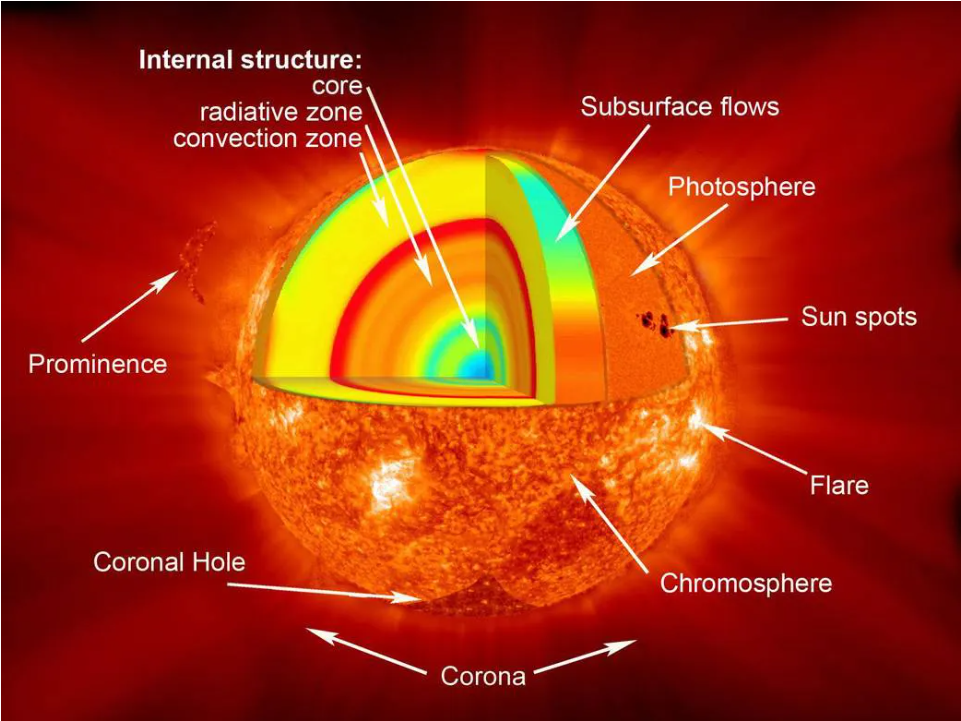
The sun creates light and heat by turning this hydrogen into helium. This process creates heat and magnetically charged particles of plasma. Much like Earth, the sun has various layers. The core is the inner most layer, the surface or photosphere and the corona. The corona extends to about 8 million miles away from the surface of the sun. It is these layers and the temperature differences between them that play a role in the auroras.
The temperature of the suns core can exceed 27 million degrees F (15 million degrees C). Meanwhile at the surface, temperatures are only 10,000 degrees F (5,500 degrees C). The corona is over 3.5 million degrees F (2 million degrees C). The reason the surface is cooler than the surface (defying conventional science) is still a mystery to scientists.
If you look at most x-ray images of the sun, you will see some dark spots, called sun spots. Sun spots are also a slight mystery to scientists. Sun spots are areas where the surface of the sun is significantly cooler than the surrounding areas. This is also a location where the magnetic field, created by the churning of chemicals, is disturbed. These sun spots are the first signs there could be a spectacular aurora in Earth’s near future.
SUN SPOTS, SOLAR FLARES AND CORONAL MASS EJECTIONS
Sun spots are identified by dark regions on the surface of the sun. They can only been seen with special cameras and satellites in space. Sun spots can be as large or even larger than Earth. Since sun spots are areas that are cooler and where the magnetic field is unstable, there can be a lot of activity in the surrounding areas.
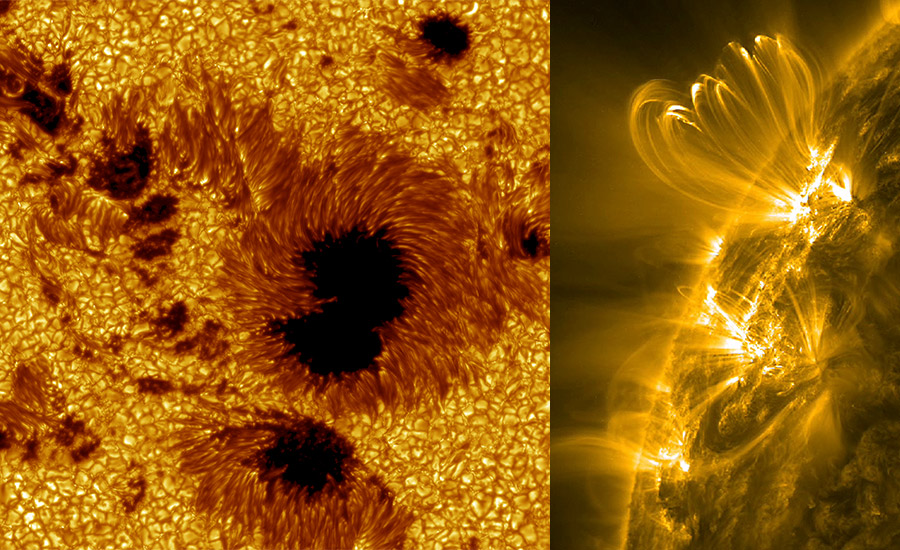
Increased activity around sunspots means there is an increase of solar flares or coronal mass ejections (CMEs). Despite the similar names, there are differences between a CME and a solar flare. A solar flare is a burst of light and radiation that can travel at the speed of light. A CME travels much slower and can take 12 hours to several days to reach Earth. CMEs are created when magnetically charged plasma particles on the surface of the sun jump between the magnetically disturbed areas of the sun spots. This burst of plasma particles across the surface means magnetically charged particles are hurled into space, sometimes called the “solar wind”.
However, it isn’t just magnetically charged plasma that causes the aurora. Earth has a process that enhances what we can see. As long as Earth is facing the location of the CME and in the correct orientation in orbit, then those living near the poles will be treated to a stunning light show.
EARTH’S MAGNETIOSPHERE
Earth’s core is full or rock and magma that is churning as it rotates. This means there is a magnetic field around our planet. This field is called the magnetosphere. It is this magnetic field that allows us to use compasses for navigation. The magnetosphere is about 80 miles above the surface of Earth at the lowest part. Some places the magnetosphere can extend thousands of miles above the Earth.
However, a strong CME traveling towards Earth doesn’t necessarily mean there will be a strong aurora. The charge of the solar wind must be the opposite of the charge of Earth’s magnetic field. If the charges are the same charge, the particles will harmlessly pass by. If the charge is the opposite, then the particles will be attracted to the poles where they will interact with the magnetic field of Earth and create the aurora borealis in the northern hemisphere and aurora australis in the southern hemisphere.

The intensity of the CME also determines what regions of the world can see it. A larger CME will emit more particles, resulting in the aurora traveling further away from the poles. Think of this like water coming out of a faucet. The more water impacting the sink, the further it will travel outwards. Generally, those living in the extreme norther and southern hemispheres are privilege enough to see the aurora on a daily basis. However, on rare occasions a strong CME will make the aurora visible in parts of the world that normally wouldn’t see it.
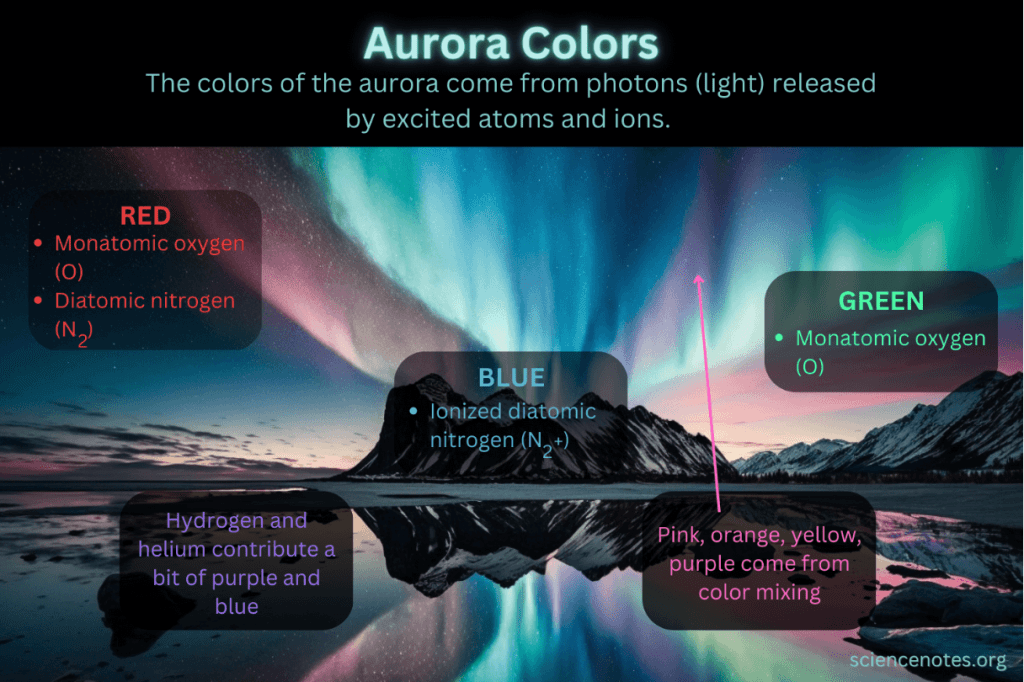
The color display is the different magnetically charged particles from the CME interacting with magnetic field of Earth. The different colors represent the different elements in our atmosphere. Oxygen atoms appear green, while nitrogen atoms appear red and helium appears purple. Since nitrogen and oxygen are most common, green and blue are the most common colors on Earth. Auroras on other planets may have a different color combination due to a different atmospheric chemical makeup.
Much like Earth going through seasons, the sun goes through periods of increased and decreased solar activity. With increased solar activity comes a greater chance of solar flares, CMEs and better auroras. These cycles, referred too as the solar maximum and solar minimum, last about 11 years. Right now our sun is approaching a solar maximum, which will peak in 2024 or 2025. The sun will return to a solar minimum in the early 20230’s. But does this increasing activity have a harmful side?
IS THE AURORA HARMFUL?
Overall solar flares and CMEs are not harmful, as long as they are protected by the magnetosphere and Earth’s atmosphere. However, it is well documented that auroras can cause satellite disruptions and communication glitches. In 1989 a solar flare disrupted and eventually shut down the power grid and plunged the entire providence of Quebec, Canada into darkness for about 12 hours. This is not an isolated event, in 1859 a solar flare disrupted telegraph systems around the world. Referred to as The Carrington Event, telegraph operators reported shocks and sparks from the telegraph machines. One report states fires broke out at numerous structures as a result from the shocks.
These incidents are not isolated. There have been many reports of communications disruptions and GPS malfunctions during solar flares. Since the flares affect the magnetosphere and ionosphere, anything relying on radio waves or a satellite signal will be affected. Most of the time the effect is caused by the charged particles blocking a signal between a satellite and a GPS device or cell phone. Other times the charge particles can create a surge in electricity, damaging electronic devices.
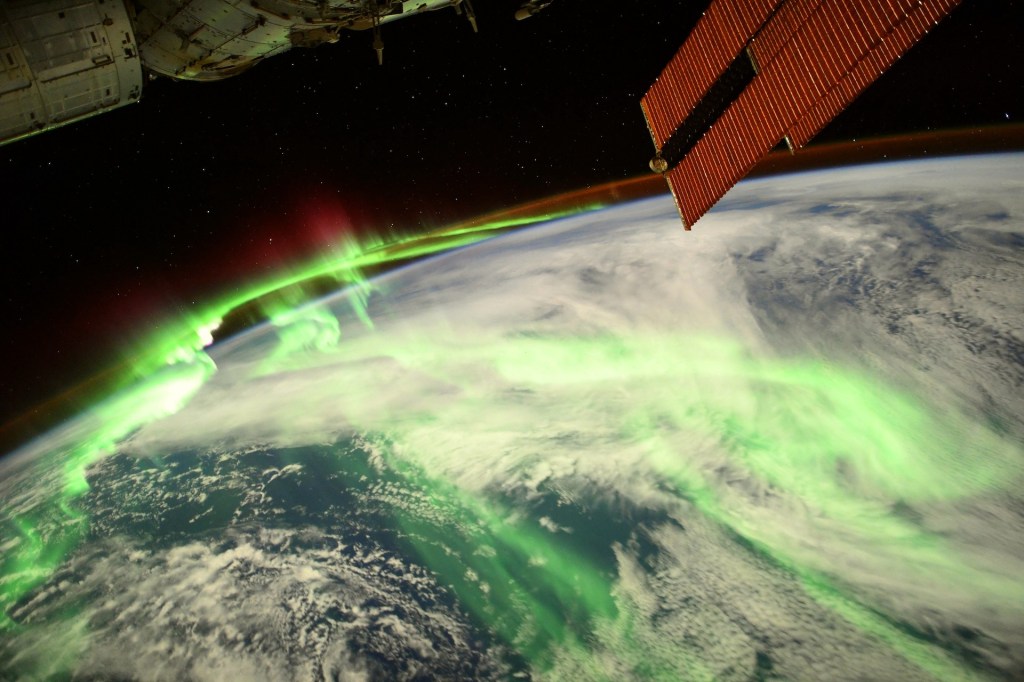
The aurora is a bucket list item that most people will spend a life savings to see. And while beautiful, just remember, the processes that cause the aurora are the same process that helps keep us alive. And when we look up at the sky to see these majestic lights, we can be sure Earth is keeping us safe down here!
REFERENCES
- https://coolcosmos.ipac.caltech.edu/ask/4-What-is-the-Sun-made-of
- https://science.nasa.gov/sun/facts/
- https://scied.ucar.edu/learning-zone/sun-space-weather/inside-sun
- https://www.weather.gov/fsd/sunspots
- https://scied.ucar.edu/image/solar-active-regions-sunspots-uv-image
- https://www.space.com/coronal-mass-ejections-cme
- https://www.rmg.co.uk/stories/topics/what-causes-northern-lights-aurora-borealis-explained
- https://www.sdsu.edu/news/2024/05/qa-as-the-sun-nears-its-11-year-solar-maximum-what-can-we-expect-here-on-earth
- https://www.swpc.noaa.gov/phenomena/ionosphere
- https://sciencenotes.org/aurora-colors-explained-southern-and-northern-lights/
 Off The Trails: A Hiker's Guide to the Outdoors