
If you’ve been following the news, you probably heard about the 7.2 magnitude earthquake that occurred near Taiwan on April 2nd, 2024. But this isn’t the only earth shaking event to raise some alarm bells. On March 28th, 2024 a 1.8 magnitude earthquake occurred near Ledyard in eastern Connecticut; and on April 5th, 2024 a 4.8 magnitude earthquake occurred in Whitehouse Station, New Jersey; about 50 miles east of midtown Manhattan. These events raise some interesting questions, are there more earthquakes now than before, are these events normal and is there something we can do about them?
PLANET EARTH
In order to understand earthquakes, we need to understand how the Earth is constructed. Earth is like an onion, there are several layers that contain rock, minerals and metals. Beneath our feet are four different layers. They are the crust, extending to a depth of between 18-45 miles beneath the surface. The mantle, which begins just below the crust extending to a depth of about 1,800 miles and is the largest of the layers. The outer core, which is liquid magma extending to about 3,000 miles below the surface. Lastly the inner core, a solid metal ball with a radius of about 750 miles.
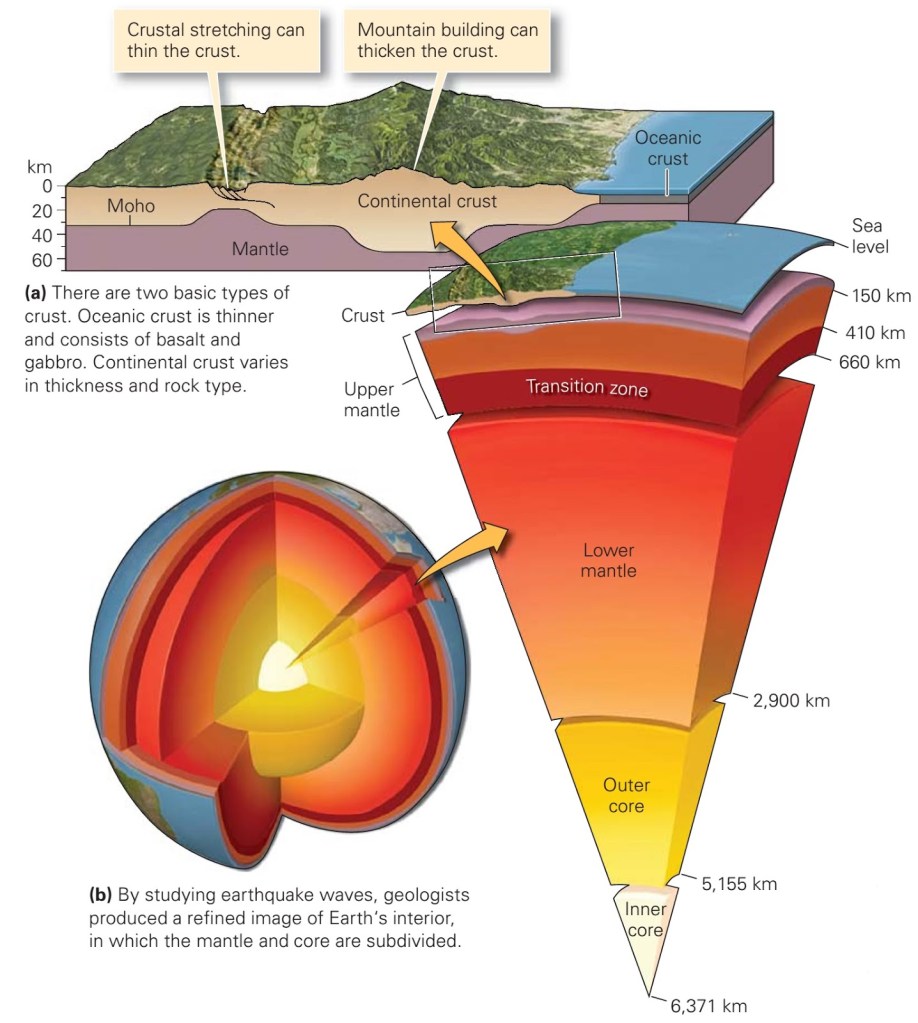
Of course there is no defined line between these layers and there are layers within layers. But the rock and metals contained deep within the Earth’s crust are what formed our planet. During the formation of Earth, these layers went through several heating and cooling periods. During this transition these layers stretched and cracked, forming massive plates that extend deep into the Earth. These plates move and stretch and this is the basic mechanisms behind earthquakes.
PLATE TECTONICS
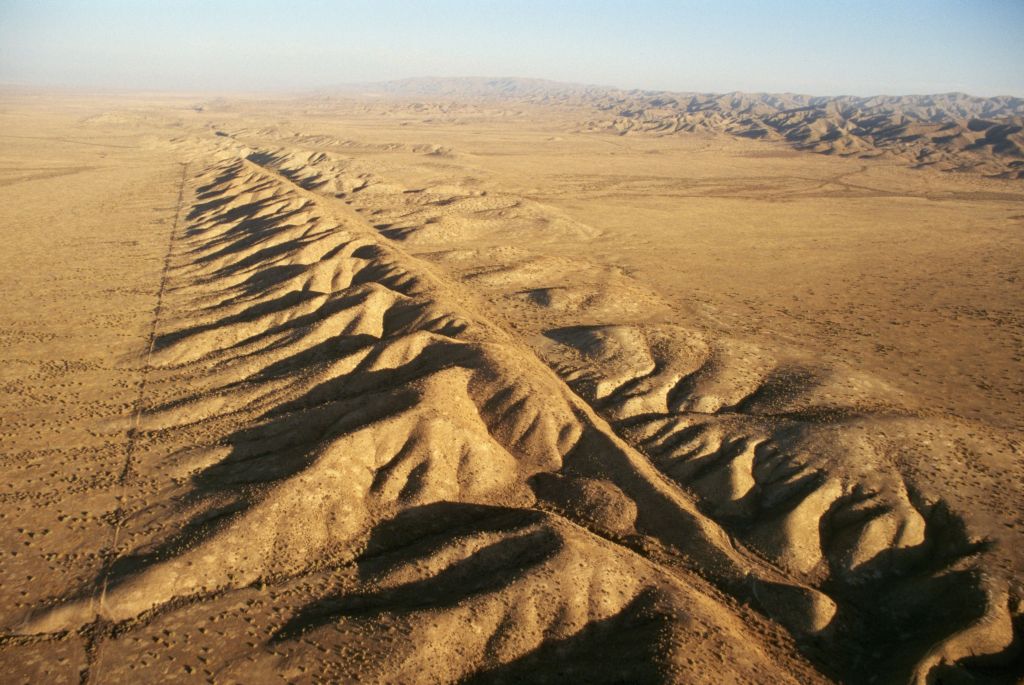
Earth is broken up into many different pieces, much like a puzzle. These pieces are not stationary, they move across the mantle in the lithosphere in varying directions. It is this movement that creates geologic features such as mountains and valleys. These pieces are called plates, and their movement is called plate tectonics. The area where these plates meet is called a fault, or a fault line.
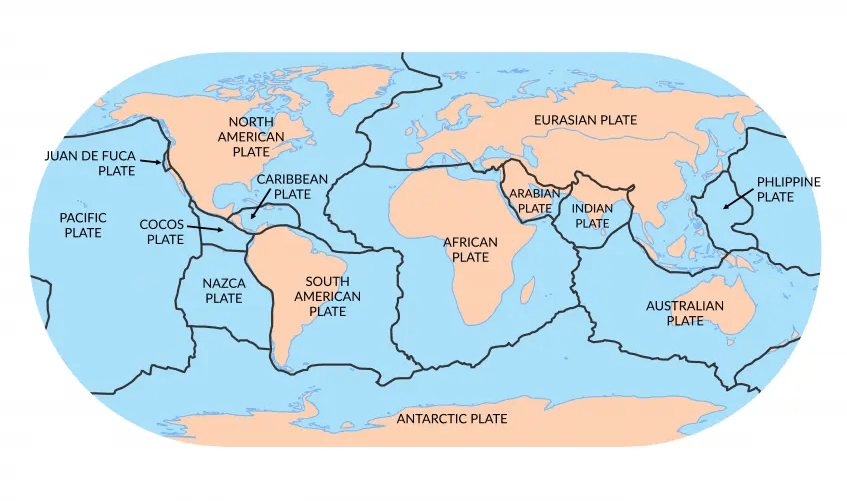
This map shows all the known tectonic plates throughout the world. It is the friction caused by plate tectonics that causes earthquakes. According to the United States Geological Survey (USGS) approximately 20,000 earthquakes occur every year, which equates to about 55 earthquakes every day. About 15-25 each year are classified as “major” (magnitude 7.0 or higher). Earthquakes also occur at different depths within the Earth. Some can be as shallow as 45 miles deep, while others can be as deep as 430 miles below the surface. The depth and location will determine the severity and amount of damage.
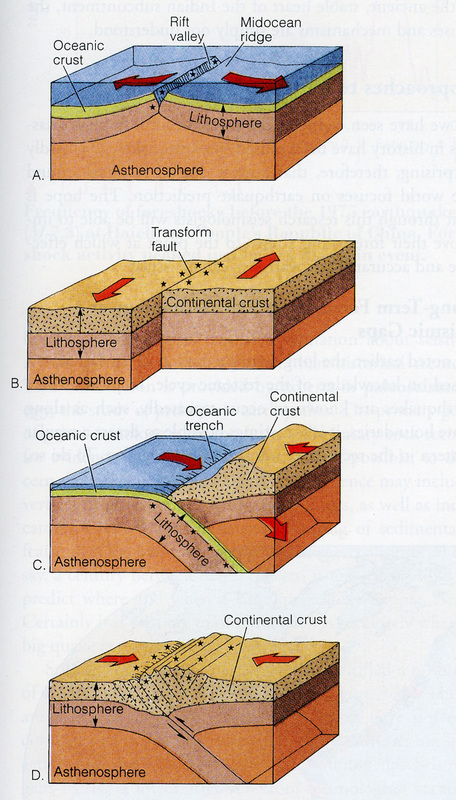
These plates are constantly moving, however, friction can sometimes grind these plates to a halt. Eventually, tectonics will overcome the friction and release the energy in a loud bang or shaking motion. This is the sound and vibration produced during an earthquake. Plates can move in one of four ways. Spreading (A) occurs when two plates move away from each other; creating a rift either in the ocean or on land, such as the East African Rift. A slip (B) occurs when two plates slide laterally. Subduction (C) is when one plate is submerged under another. It is this type of tectonic activity that creates volcanos. A collision or strike (D) occurs when two plates collide and begin to push upwards. This type of tectonic activity is what forms mountain ranges like the Himalayas.
If you notice, areas prone to earthquakes such as California and Asia, sit directly on a major plate boundary. Pacific areas such as Indonesia and Hawaii are prone to volcanic activity. Subduction can occur at a plate boundary, and one plate is pushed deeper into the Earth’s core, where it begins to melt. The melting rock forms a lava chamber. As lava and magma heat, it rises to the surface and cools in the form of a volcano. These volcanos occur all along the submerging plate and begin to form an arc. If this occurs in the ocean, new islands can form next to a submerging oceanic trench.
Sometimes a vertical or lateral change in underwater terrain can occur during an earthquake. If this change is big enough and occurs beneath the ocean, a tsunami can form. The changing terrain displaces the water and forms a large wave. Think of this like dropping a rock into a puddle, the rock displaces the water crating a wave in all directions. Aftershocks can also create smaller tsunamis that can do further damage to an already affected area.
Foreshocks and aftershocks are also common in earthquake regions. Foreshocks are smaller earthquakes before a main event; while aftershocks are smaller earthquakes after the main event. Both episodes occur when the affected plate is experiencing minor adjustments before or after a main earthquake event. Aftershocks are generally more dangerous as they can lead too additional damage to the areas affected by a main earthquake. Aftershocks can also halt rescue efforts and further injure or isolate those needing immediate medical attention. A magnitude 9.0 earthquake has the potential to produce an aftershock of 7.5 or greater.
MAGNITUDE
The largest earthquake ever recorded occurred on May 22nd, 1960 off the coast of Chile and registered a 9.5 on the Richter Scale. The earthquake generated tsunamis that not only affected Chile, but went all the way across the Pacific Ocean, hitting Hawaii, Japan and the Philippians along the way.
The science relating to the study of earthquakes is called Seismology and a device used to pinpoint the exact location of the earthquake is a seismograph. A seismograph is an instrument with a pen suspended above some paper. As the ground shakes, the pen creates a a squiggled line, depicting ground movement. The Richter Scale, developed by Charles Richter in 1935, is the most widely used way of detecting earthquakes.
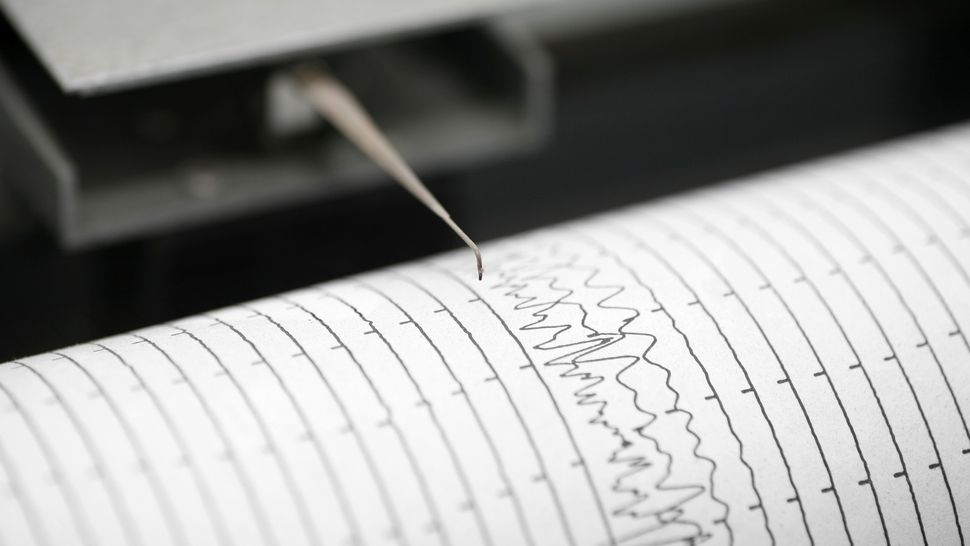
The Richter scale is a scale numbering from 1-10 with 10 being the most severe and 1 being the least severe. The magnitude is determined by the largest deflection of the line during the earthquake event. The larger the deflection, the higher the magnitude. Another way to measure the intensity is to calculate the energy released at the moment of effect. However, this technique is still new and procedures are still being defined.
BENEFITS OF EARTHQUAKES
Believe it or not, there are benefits to earthquakes. Different rocks absorb sounds and vibrations differently. Scientists can study the waves produced by the earthquake to better understand the rocks and materials making up the Earth’s core. Not only do we learn about Earth’s core, earthquakes are signs that our planet is changing and healing.
If they did not occur, Earth would likely be uninhabitable. Earthquakes can allow mother nature to repair damaged crust. As liquid magma rises to the surface, then cools and hardening, new land is formed for all forms of wildlife. Tectonic activity allows minerals and essential metals to be cycled out of Earth’s core. This cycling enriches soil and provides essential nutrients to plants and animals. Diamonds and other precious stones are created through the same tectonic activity that causes earthquakes. Volcanos also release built up carbon dioxide and other toxic gases as well as help regulate the core temperature of Earth. When Earth’s core is overheating, magma can escape through the volcano. Earthquakes also build mountains, create new land, and creates new habitats for all forms of life.
Earthquakes are one of the deadliest and most dangerous natural disasters on Earth. Predicting them is nearly impossible and some of the largest earthquakes can occur without any warning. There is almost nothing we can do to stop them other than engineer our buildings to withstand the shaking. As long as humans inhabit the Earth, we will have to live knowing this is one essential process that we can’t control or predict.
REFERENCES
- https://earthquake.usgs.gov/earthquakes/eventpage/us7000m8j3/executive
- https://earthquake.usgs.gov/earthquakes/eventpage/us7000m9g4/executive
- https://earthquake.usgs.gov/earthquakes/eventpage/at00sbh3yv/executive
- https://www.snexplores.org/article/explainer-earth-layer-layer
- https://www.britannica.com/science/plate-tectonics/Seafloor-spreading
- https://www.amnh.org/explore/ology/earth/plates-on-the-move2
- https://www.space.com/earthquakes-facts-science
- https://www.bostonglobe.com/2023/02/15/opinion/earthquakes-bring-death-also-life/
- https://www.amnh.org/explore/ology/earth/power-of-plate-tectonics/earthquakes
- https://www.usgs.gov/programs/earthquake-hazards/determining-depth-earthquake
- https://www.usgs.gov/faqs/foreshocks-aftershocks-whats-difference
- https://www.ngdc.noaa.gov/hazard/22may1960.html
 Off The Trails: A Hiker's Guide to the Outdoors