
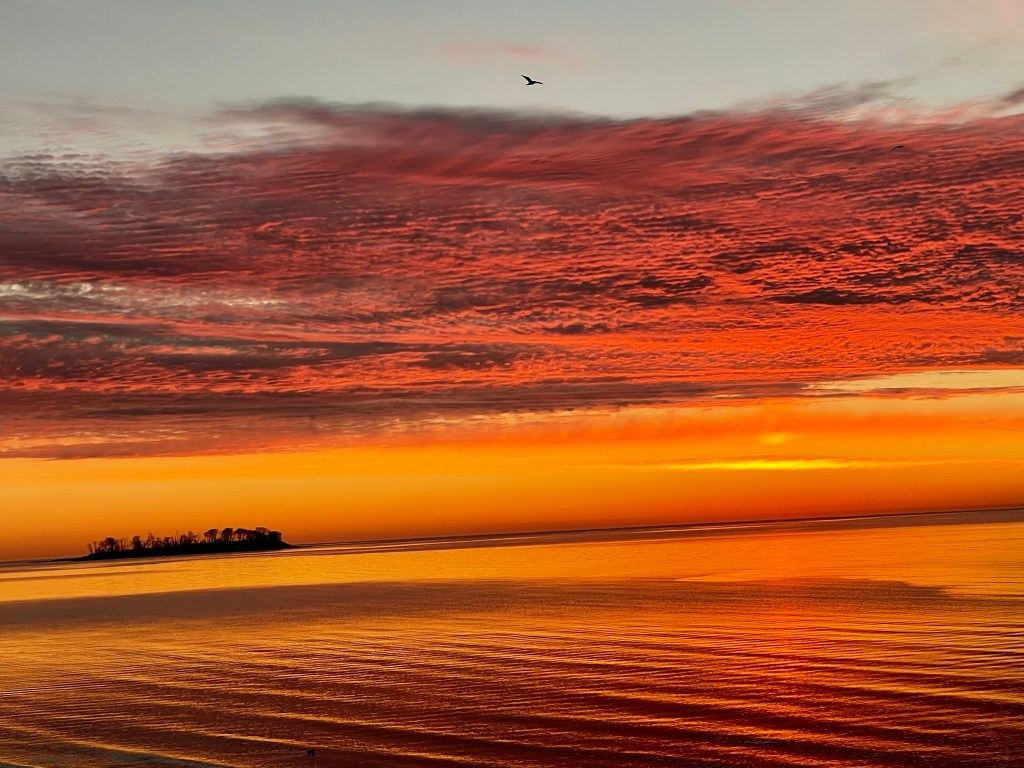
If you are an early riser, or just someone who likes to watch the sun set, you may notice that once in a while, the sun lights up the sky with spectacular colors of red, yellow and orange. But, what exactly is happening in our atmosphere to create these vibrant colors, and is there a difference between a red sky in the morning and a red sky at night?
SUNLIGHT AND THE ATMOSPHERE
Understanding the sunrise and sunset phenomena, we need to discuss our atmosphere and how light is affected when it passes through. Simply put, colors and light behave like a wavelength. Each color is a specific wavelength on the color spectrum. The length of the waves determines the color. The colors blue and violet have a very short wavelength, while red is one of the longest. White light is actually the presence of all visible colors on the color spectrum. As white light from the sun passes through our atmosphere, it scatters into the various colors. This the same effect as light passing through a prism.
Blue light, because of the short wavelength, is easily scattered by our atmosphere and easily recognized by our eyes. This is why the sky appears blue during the day. The sun emits a very low concentration of violet light in comparison to a high level of blue light. The low concentration means we do not see a violet sky during the day, even though the wavelength is very short and scattered just as as easily.
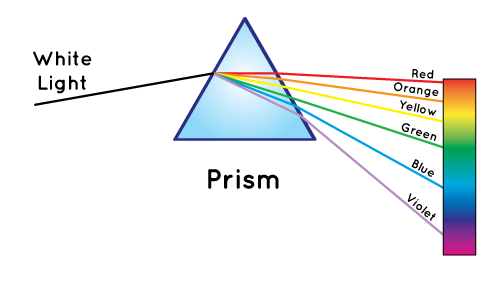
Water molecules have the same effect on sunlight. It is this effect that often creates rainbows after thunderstorms.
A helpful way to remember this process: the longer the wavelength, the more atmosphere needed to make longer wavelengths of color visible. When the sun is rising or setting, there is more atmosphere that sunlight has to travel through. The increased distance and atmosphere means blue light is scattered and disbursed, while red and orange colors become visible. The removal of blue light results in dawn and dusk skies appearing red and orange. This scattering effect is called Rayleigh Scattering. However, Rayleigh Scattering only explains why the sky changes color when the sun is close to the horizon. It doesn’t explain why some sunrises/sunsets are more vibrant and colorful than others. For that, we need to discuss the weather.

RED SKY IN MORNING?
If you spend any time on the water or are a sailor, you may have heard the saying “red sky at night, sailors delight. Red sky in morning, sailors take warning.” This saying means, a red sunrise will bring bad weather, whereas a red sunset will bring calm weather and clear skies. Is there any truth to this, and is there a difference between a red sky in the morning and a red sky at night?
Our atmosphere is unstable; it is constantly changing. There are areas of high pressure and areas of low pressure. However, nature wants everything to be equal. If there is an area of low pressure, air will rush into the system in an attempt to make the pressure equal. This can create high winds and unstable air that can produce bad weather. Areas of low pressure are more likely to contain water, bring rainstorms. An area of high pressure means there is more air present than in surrounding areas. The resultant effect is air being pushed away, creating clear skies and calm winds.
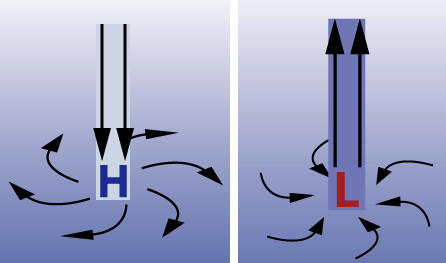
So a high pressure system means good weather while a low pressure system means bad weather. Our sun will set in the west and rise in the east. Weather travels west to east. Now remember, a lot of atmosphere (like in a high pressure system) means the sky will be very red at dawn or dusk.
Knowing this information, a bright red sky is created by a high pressure/good weather system. If that system is east of you (as in the direction of the rising sun), then the high pressure/good weather has passed and you will soon encounter a low pressure/bad weather system (traveling behind to fill the vacant air). If the high pressure/good weather/red sky is west of you (illuminated by the setting sun), then the high pressure/good weather is coming your way. Although there is some truth to the saying; there are also exceptions and many other factors that contribute to a bright red sunrise/sunset.
While temperature has very little effect, cold air is crisper and less humid, which helps promote the Rayleigh Scattering. Red sunrises/sunsets may be more prominent in winter months due to the crisp air. Cloud cover may also be a factor in how red the sky is at dawn or dusk.
Earth, our sun, and the solar system are incredible feats of creation that researchers barely understand. Predicting the weather, or the color of the sky is like trying to win the lottery. It is nearly impossible to fully understand the power of nature. We can only appreciate the beauty of mother nature when she decides to play the cards right. Just remember, if you’re planning a hike and see a red sky while getting ready to leave, check the weather and make sure you don’t get caught in the in the rain.
References
Information and pictures derived from the following websites:
- https://spaceplace.nasa.gov/blue-sky/en/
- https://scied.ucar.edu/learning-zone/how-weather-works/highs-and-lows-air-pressure
- https://www.loc.gov/everyday-mysteries/meteorology-climatology/item/is-the-old-adage-red-sky-at-night-sailors-delight-red-sky-in-morning-sailors-warning-true-or-is-it-just-an-old-wives-tale/
- https://www.scientificamerican.com/article/is-there-scientific-valid/
- https://scijinks.gov/high-and-low-pressure-systems/
- https://www.metoffice.gov.uk/weather/learn-about/weather/optical-effects/why-is-the-sunset-red
- https://www.rmg.co.uk/stories/topics/why-sky-blue
- https://www.sciencedaily.com/releases/2007/11/071108135522.htm
 Off The Trails: A Hiker's Guide to the Outdoors